Freetown
Village
REDESIGNING PLATFORM EXPERIENCE AND REVENUE SUSTAINABILITY
0-1
B2C
REVENUE MODELLING
Client
Freetown Village
Team
Team of 4
My Role
User & business researcher, Product Designer
Duration
12 Weeks
PROBLEM
Freetown Village's value lives in embodied, shared, live experiences, performances, storytelling, and community dialogue, but that value was tied entirely to physical space, with no way to scale beyond it or sustain itself financially between events.
SOLUTION
A digital cultural ecosystem built on two inseparable core experiences: live Watch Parties and a personal 3D Museum connected by a sustainable revenue model and an IoT layer bridging physical events to the digital platform.
OUTCOME
01 — OVERVIEW
Overview
Freetown Village is a living history museum that preserves African American history through live performances, storytelling, and community dialogue.
Unlike a traditional museum, its value isn't in static exhibits, it's in embodied, shared experience, which made ‘digitize the museum’ the wrong framing from the start. The final outcome is not just a digital product, but a cultural platform combining:
Watch Parties - live and recorded communal viewing
A personal 3D Museum - individual, persistent ownership of what a user has experienced
A revenue model - treating sustainability as part of the experience, not an afterthought
An IoT-enabled ecosystem - connecting physical, live events to the digital platform
02 — THE PROBLEM
The Problem
This wasn't approached as a typical ‘design a feature’ problem; it was treated as a systemic challenge across users, culture, business, and technology at once. A purely digital archive would solve the ‘beyond physical space’ half of the question and fail the ‘experience it together’ half; a purely social platform would risk losing the cultural authenticity that gives Freetown Village its value in the first place. The problem statement had to hold both halves simultaneously.
How might we help people experience African American history together and build lasting cultural ownership, while enabling Freetown Village to scale its mission sustainably beyond physical space?
03 — RESEARCH
Research
Research combined primary and secondary methods to triangulate both user behavior and the competitive landscape:
Stakeholder interviews
User interviews
COMPETITIVE RESEARCH
EARLY USABILITY TESTING
FOCUS GROUPS
DATA SYNTHESIS

This concentration was itself a finding: a mission this reliant on grant funding has no direct lever tied to audience growth or engagement, which shaped the entire premise that the platform needed its own revenue model, not just a content strategy.
Market Positioning Map
Freetown Village was benchmarked against four platforms on a single community-engagement scale (0–9):
COMMUNITY ENGAGEMENT · 0 TO 9 SCALE
Mighty Networks
9
Smithsonian Associates
5
KweliTV
3
BroadwayHD
1
Sets the ceiling, not a direct competitor
Cultural / streaming platforms
Mighty Networks' high score reflects a fundamentally different product (a general-purpose community platform), not a direct competitor, but it set the ceiling for what ‘community engagement’ could look like. The real finding was the gap beneath it: no existing cultural/streaming platform in this space scored above a 5, meaning genuine community engagement was the open opportunity, not a crowded one.
Key Findings
01
Digital history often feels like reference material, not lived experience. Users want to feel connected to the narrative, not just informed by it.
02
Trauma-focused narratives dominate online Black history content. Users wanted creativity, continuity, and joy represented alongside struggle, not struggle alone.
03
Shared experiences significantly increase emotional resonance. Community amplifies meaning and memory in a way solo consumption doesn't.
Quantitative Signals
User interviews and data synthesis converged on four needs that shaped every downstream decision:
Early Usability Validation
Before committing to a concept, three core assumptions were tested directly rather than assumed:
SOLO VS SHARED LEARNING
PASSIVE VS PARTICIPATORY FORMATS
PRESENCE OR ABSENCE OF PROGRESSION
WHAT WE FOUND
Shared experiences held attention longer than solo ones
Passive consumption caused disengagement
Users wanted something lasting to carry forward after learning, not just a completed session
04 — IDEATION
Ideation
With the problem clearly defined, multiple experience models were explored deliberately without converging early
CONCEPTS Explored
STATIC DIGITAL ARCHIVE
COURSE-BASED LEARNING
COMMUNITY FORUM
STREAMING ONLY
HYBRID LIVE + PROGRESSION
Low-fidelity sketches focused on experience flow, not UI polish, specifically how users enter, where the emotional peaks occur, and what motivates a return visit.

KILLED
What we killed and why
A static digital archive and course-based learning were both rejected for the same underlying reason — they treated history as content to consume, which the research had already shown produces disengagement and no lasting connection. A community forum alone lacked the emotional peak of a live shared moment; streaming alone lacked a reason to return once a session ended.
No single model worked in isolation. The strongest concepts combined shared experience with personal ownership exactly the combination no single explored model offered on its own.
05 — THE BET
The Bet
Four principles, drawn directly from research synthesis, governed every decision from this point forward
01
Trust before scale. Cultural authenticity is non-negotiable.
02
Participation over consumption. Active engagement drives retention.
03
Community over virality. Depth of connection matters more than reach.
04
Progression builds identity. Ownership creates lasting engagement.
The bet: neither a purely social feature nor a purely archival one would work, the platform had to combine a shared, live moment with something a person could personally keep, or it would repeat the same disengagement the research had already surfaced.
A shared live moment, plus something you get to keep.
06 — THE SOLUTION
Solution 01- Watch Parties
THE IDEA
Live and recorded cultural performances
Public and private rooms
Real-time chat, polls and quizzes
WHY WATCH PARTIES
Replicate Freetown Village's in-person performances directly, rather than translating them into a different format
Reinforce learning as communal, matching the ‘shared experiences increase emotional resonance’ finding
Build emotional resonance and trust, the foundation the ‘trust before scale’ principle demanded
History is remembered socially, not individually.
Solution 02- Personal 3D Museum
The second, inseparable half of the bet: give each user something of their own to build and keep, so the platform offers more than a session that ends when the stream does.
CORE PROTOTYPE FLOWS TESTED -

07 — TESTING
Testing
Usability testing measured task success across the core flows before wider validation:
TASK SUCCESS RATE
Join Watch Party
92%
Participate in chat
88%
the familiar loop ends here
Understand points
75%
Find artifact
70%
Navigate museum
65%
Core communal loop
Newer, less-familiar mechanics
The pattern is clear across the flow: the core communal loop (joining, participating) tested strongly, while the newer, less-familiar mechanics (points, artifacts, museum navigation) tested weaker, a natural target list for the next iteration rather than a red flag on the concept itself.
08 — REVENUE
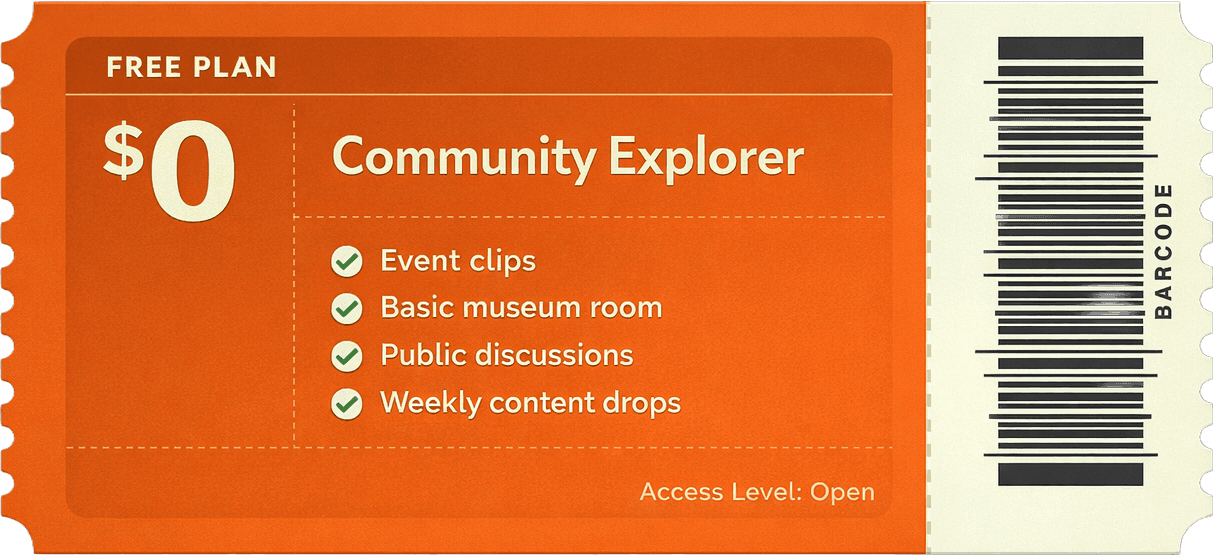
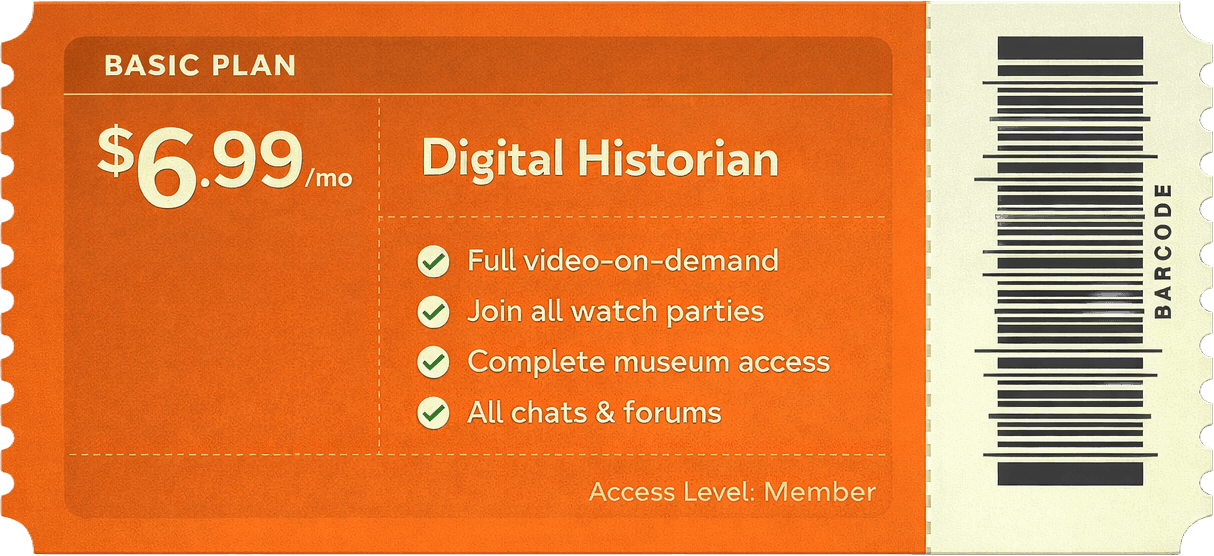
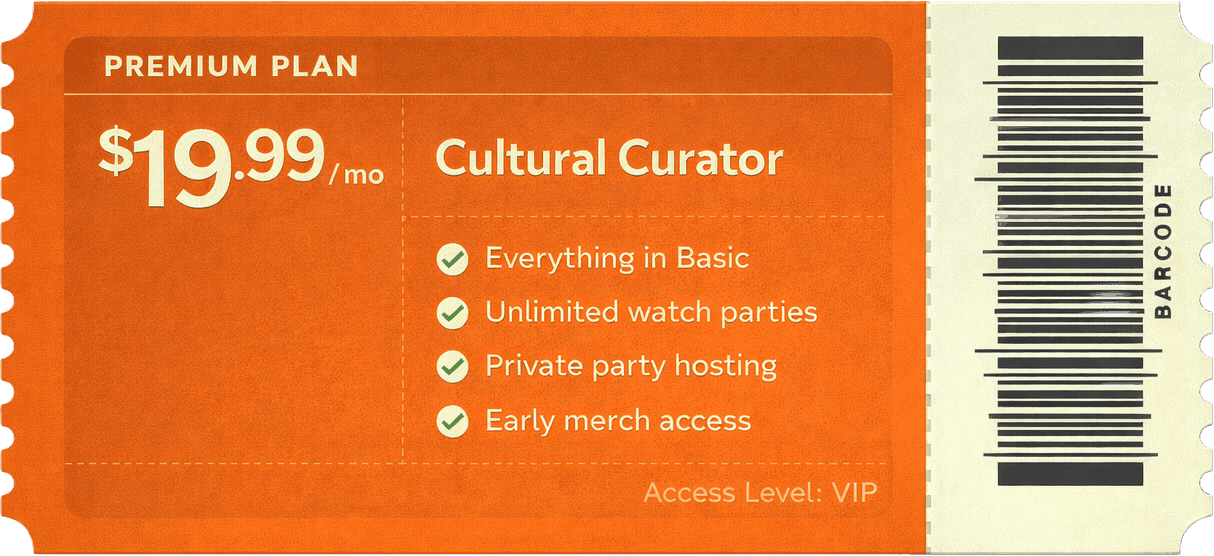
Revenue
Revenue was designed as part of the experience itself, not layered on afterward, directly addressing the 80%-grant-dependency finding from research.
09 — IoT Ecosystem - Bridging Physical & Digital Culture
IoT Ecosystem - Bridging Physical & Digital Culture
The platform extends beyond screens into an IoT-enabled layer, closing the loop between attending a live event and the digital ownership model.
SMART TV CASTING FOR WATCH PARTIES
QR/NFC ARTIFACT UNLOCKS AT LIVE EVENTS
MULTI DEVICE SYNCING
10 — IMPACT
Impact
Usability testing validated the core communal loop before further investment, and the revenue model directly addressed the structural funding problem the research surfaced.
92%
Task success - joining a Watch Party
88%
task Success - Participating in Live Chat
3
Revenue tiers replacing single source grant reliance
80%
Prior grant dependency, the model was designed to reduce
11 — NEXT STEPS
Next Steps

12 — Conclusion