A re-engagement system for Salesforce Trailhead’s most advanced learners - built with Salesforce, for the users the platform was starting to lose.
Enterprise UX
Enterprise SaaS / EdTech
Client
Salesforce Trailhead
My Role
Product Designer & ResOps Lead
Team
Team of 5
Duration
10 months
PROBLEM
Salesforce's most experienced users were taking their questions to ChatGPT and Slack instead of Trailhead's own community, and between milestones, nothing gave them a reason to come back.
SOLUTION
Plain-language answers to real Salesforce problems inside Trailhead, paired with proactive prompts that surface what's relevant next without being asked.
OUTCOME
01 — OVERVIEW
Overview
Trailhead is Salesforce's free online learning platform, taking millions of professionals from beginner to certified expert. It was built for the climb and it loses experts the moment they reach the top.
Over 10 months, our team of five partnered with the Salesforce Trailhead product team to research, design, and build for the platform's most experienced users: the power users who built their careers on Trailhead, then quietly stopped coming back.


02 — THE PROBLEM
The Problem
Salesforce's ecosystem runs on its community of experienced users who answer questions, mentor newcomers, and champion the platform. Those power users were the engine of it, and they were showing up less and contributing less.
Not churning.
Drifting.
03 — RESEARCH
Research
I ran research operations end to end, reaching 650+ Salesforce professionals across the US, India, Canada, Europe, and the Middle East, qualifying 72 as power users, and interviewing 11 across two rounds.

RECRUITMENT FUNNEL · TWO ROUNDS
650+
Professionals reached
72
Qualified as power users
11
Interviewed in depth
Round one focused on opinion: how people felt about Trailhead and what would make it more inspiring. It gave warm, agreeable answers and no real direction.
Round two focused on behavior: what people actually do, where they drop off, whether they use the community and why not, and whether certifications even move the needle on their actual goals. That's where the real pattern surfaced.
Alex - The Architect
Confident Amplifier
Opens ChatGPT first when a real problem hits.
Certifications are tied to billing rates and performance reviews.
Jenny The Developer
Focused Professional
Certifications tied to reviews.
Pauses under workload and finds no clear way back in.
04 — FINDINGS
Findings
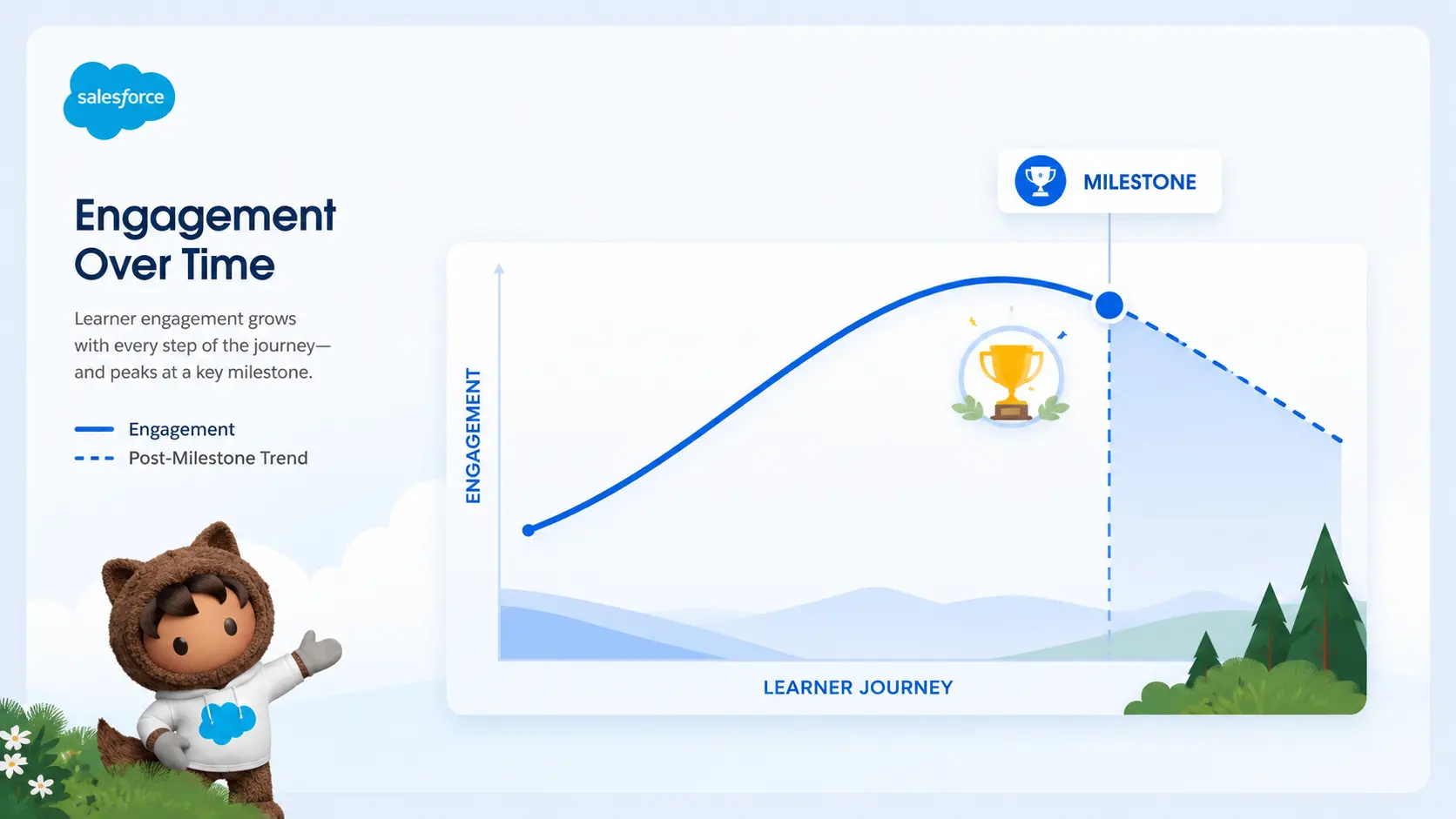
Power users dropped off right after milestones like certification. Between those moments, they took their questions to ChatGPT and YouTube for a faster answer, despite a community on the platform built for exactly those questions.
64%
Disengaged after major milestones like certifications
45%
Supplemented Trailhead with ChatGPT, YouTube, and Slack
45%
Found the content too shallow for their experience
36%
Were unhappy with the existing personalization
05 — IDEATION
Ideation
Of everything we explored, two ideas stood out enough to skip wireframes entirely and vibe-code straight into working proofs of concept. Neither held up, and killing them is what shaped the two features we actually shipped.
✕ KILLED
THE IDEA
Status plus leverage. Power users become group leads; an AI trained on their own posts answers community questions on their behalf.
WHY WE KILLED IT
Fully automated meant an undisclosed AI speaking as a real person a direct trust violation. Adding disclosure or an approval step clashed with Trailhead's warm, human brand and the real anti-AI anxiety among users, and the approval version stopped saving anyone time, which defeated the entire point. Underneath both paths, our research was clear: these users didn't want more community obligation; that wasn't the reason they'd come back.
✕ KILLED
THE IDEA
Make skill currency public, and the visibility itself pressures people to keep it current. A shareable Trailhead profile showing certifications, badges, and skill levels tied to how current your learning is, replacing the scattered cert posts people already drop on LinkedIn.
WHY WE KILLED IT
Two reasons. First, it only works if the outside world employers and LinkedIn networks treats the profile as a real credential, and that adoption was entirely outside our control. Second, even if it caught on, it would drive engagement for its own sake, not the meaningful, lasting reason to return we were actually after.

06 — THE BET
The Bet
ChatGPT runs on public data. Slack answers depend on whoever happens to reply. We bet that Salesforce's own proprietary knowledge, delivered in plain language, could beat both.
That bet became two connected features: Solve catches power users at the moment they'd otherwise open ChatGPT, and a proactive system resurfaces what's relevant next so returning is worth it. Neither works alone.
Proprietary knowledge, in plain language, at the exact moment of friction.
07 — THE SOLUTION
Solution 01- Trailhead Solve
Solve answers a real Salesforce problem in plain language, on the spot, calibrated to your expertise and backed by sources you can check.
01
Ask a problem in plain language; get a specific, actionable answer that cites Salesforce documentation.
02
Set the depth to Beginner, Intermediate, or Advanced, so you're never over-explained or underserved.
03
When Solve can't fully help, it drafts a ready-to-post Trailblazer Community question from your conversation so you get an answer either way.
We designed for the moment the AI can't help, not just the moment it can.
Solution 02- Proactive Prompts
Without being asked, the system surfaces what's relevant to each expert: skill gaps against the market, follow-ups from their own questions, and renewals before they lapse.
01
Before a certification lapses, it flags the renewal on its own, closing a notification gap users complained about directly.
02
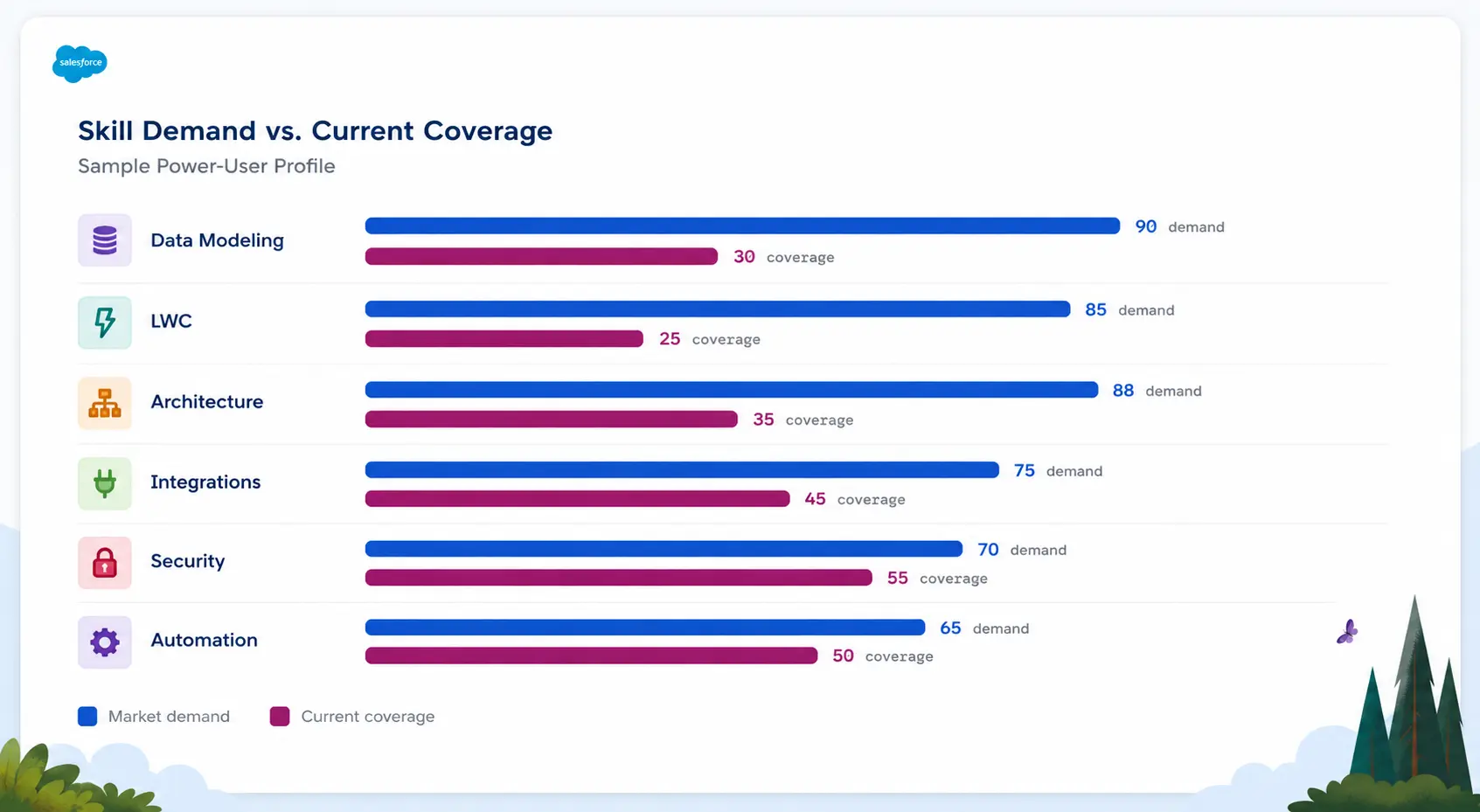
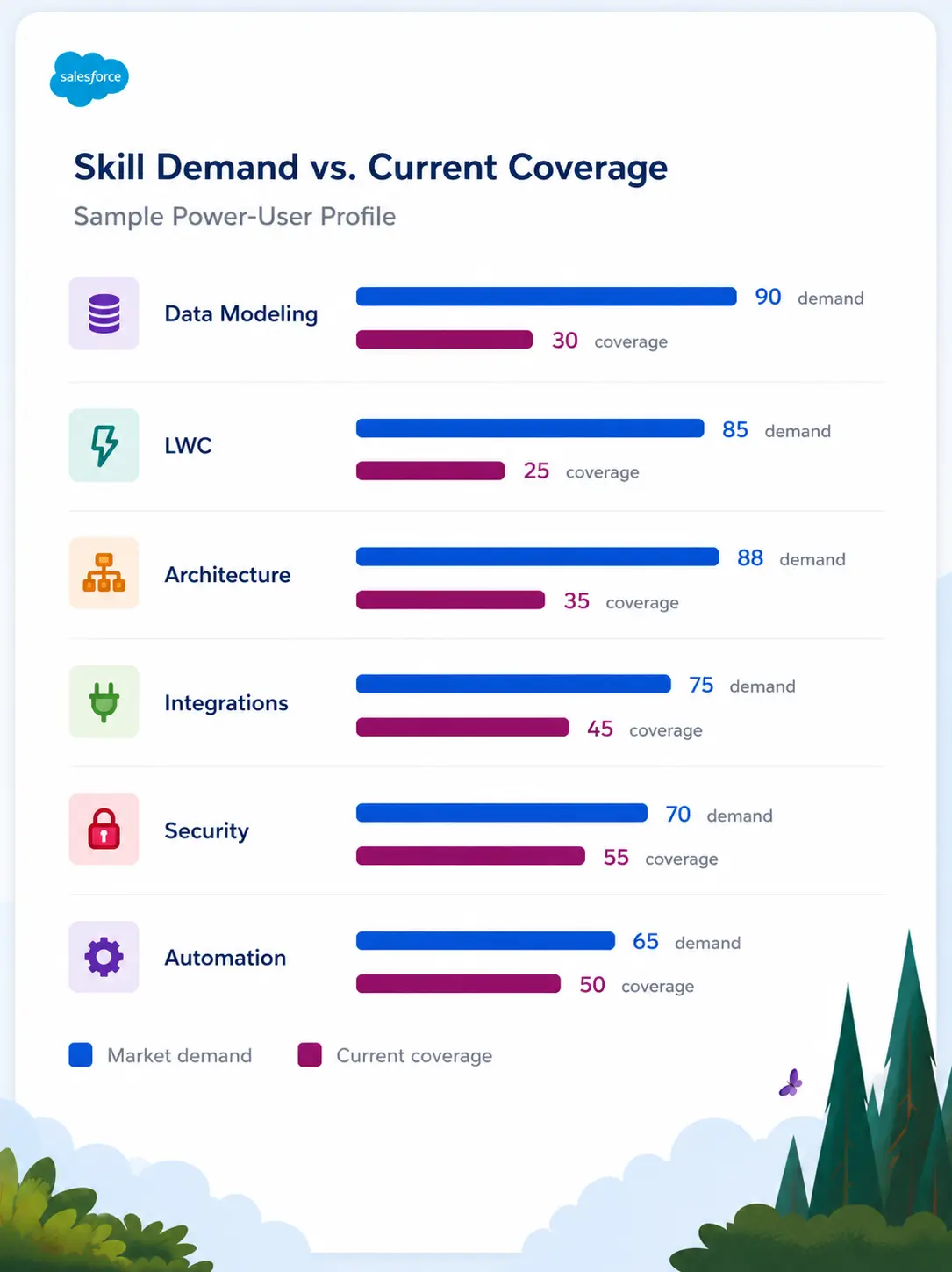
Unprompted, it measures a user's skill profile against what the market is hiring for and builds a path to close the gap it finds.
03
It reads the questions a user asked Solve and recommends what to learn next so the follow-up finds them, instead of waiting to be searched for.
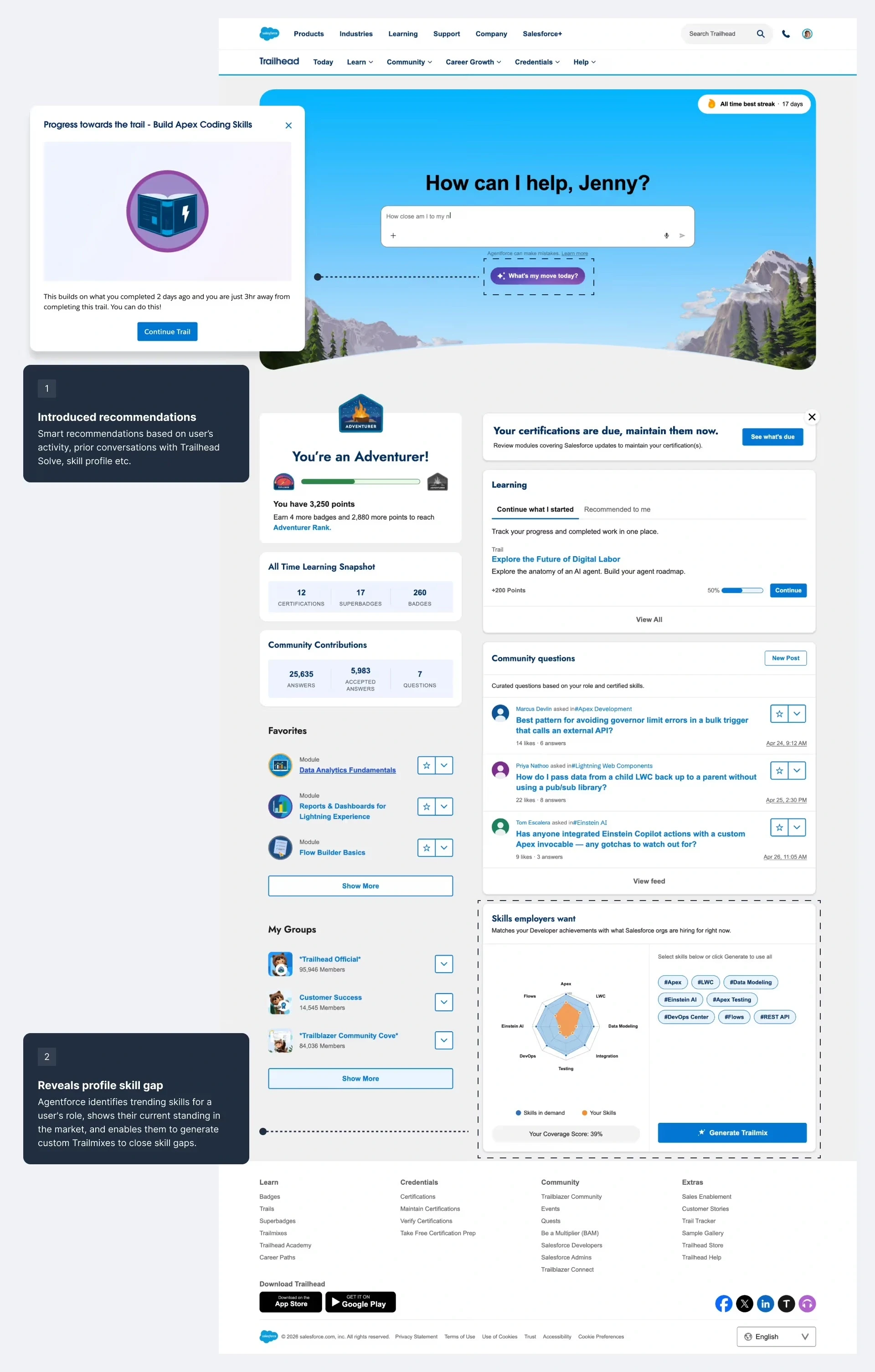
None of this waits for a request. The platform does the noticing and brings the next step to the user.

08 — THE BUILD
The Build
Figma MCP took each component straight into Cursor and Claude Code, where it was wired to the OpenAI API and shipped as a working app, not a mockup.
React
Express
SQLite
OpenAI
Voice Input
After designing each component in Figma against Trailhead's design system, the team built it piece by piece, with no handoff and no rebuild from spec. The result: a React front end, an Express and SQLite back end, OpenAI for responses, voice input, expertise calibration, and community-post drafting, all running.
Taking a concept from design straight to working software instead of a slideshow is what lets the team test it like a real product.
09 — AGENTIC TESTING
Agentic Testing
Real power users were hard to get hold of, so the team built 12 AI agents from the research data to catch the obvious problems before spending anyone's real time.
By the time real users arrived, the rough edges were already smoothed, and their time went to what actually needed a person.
10 — IMPACT
Impact - I
We tested whether Solve could replace the reflex to open ChatGPT. Each participant took a real Salesforce question, asked it to both ChatGPT and Solve, and compared.
6/8
Preferred Solve over ChatGPT
4.5/5
Confidence in Solve's answers
Impact - II
The prototype pulled power users back into the content, lifting session duration and cutting drop-offs.
+35%
Session duration
-22%
Drop-off
11 — MY LEARNING
My Learning
What worked
Designing for users who’d already arrived gave every decision a clean test.
What was hard
Recruiting authentic power users on a semester timeline.
What’s next
Scale testing globally, refine Solve’s answer quality, pitch a formal roadmap.